
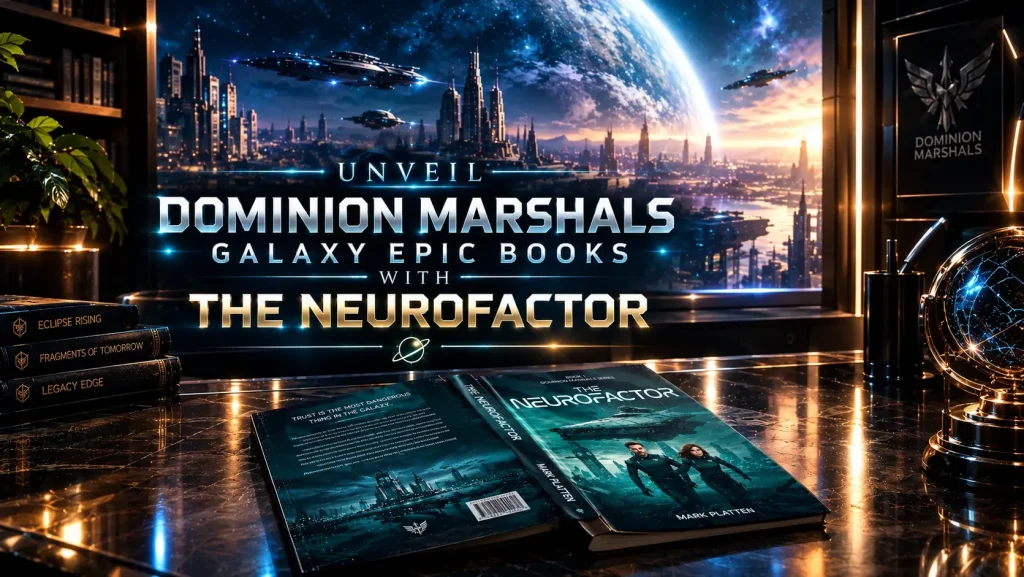
Mark Platten’s Dominion Marshals series kicks off with The Neurofactor, set in a galaxy where a scoring system built to read people’s character often ends up shaping it instead. Rather than lean on spectacle, the story builds tension through political deals that quietly unravel and small, easy-to-miss clues planted early that only make sense in chapters later. Platten’s background in engineering gives the world a grounded, lived-in feel, and with Eclipse Rising, Fragments of Tomorrow and Legacy Edge already on the way, this is the natural place to start before the series expands further.
Introduction
Most space opera hands you a war and calls it a plot. The Neurofactor does something different. It opens with a question, not a battle. What happens when a tool built to judge someone’s character starts to shape it instead? So if you want to unveil Dominion Marshals galaxy epic books from page one, this book is the right place to start. Everything later builds on it.
Where To Unveil Dominion Marshals Galaxy Epic Books First
The Dominion Marshals patrol a rough stretch of the galaxy. Out there, paperwork moves slower than trouble does. So the Marshals lean on a system called the Neurofactor. It reads personality, risk and hidden motive, then hands back a score. The Marshals trust that score without asking many questions. If you want to read this series in the right order, start right here. Every later title builds on this one.
The system never turns into a cartoon villain. Instead, it works more like a mirror. Sometimes it shows exactly who someone is. Sometimes it shows who they fear becoming instead.
Inside The Prism, One Piece Of A Lived-In Galaxy
Extra material tied to this world introduces The Prism. A former agent built this small intelligence post. She left her old team behind first, then trusted her own network more than the official one. You don’t need this material to follow the main story. But once you read it, early choices in the novel start to look planned instead of random.
That kind of texture sets a real world apart from a rushed one. Nothing here feels bolted on just to fill a chapter.
A Best Sci Fi Neurofactor Novel Built On Doubt, Not Certainty
Many readers already call this a best sci fi Neurofactor novel, and it’s easy to see why. They expect a laser fight. Instead, they get a slow, tense unraveling. The Marshals sent into the opening mystery don’t get clean intel. They get pieces that don’t fit yet. Meanwhile the scoring system keeps saying it stays neutral, even while everyone treats it like a weapon.
The tension here doesn’t come from a countdown clock. It comes from watching people decide, again and again, whether to trust a number they can’t fully check. That kind of dread lasts. It doesn’t fade after one big scene. At its core, this stays a dark Neurofactor science mystery. It leans on tension, not spectacle.
Politics That Never Resolve Neatly
Alliances in this galaxy hold for one simple reason. Breaking them costs too much, until suddenly it doesn’t. Factions trade favors. They also sit on old grudges. Then they quietly test how far a rival will bend before something snaps.
Some of these deals last through the whole book. Others fall apart off the page, mentioned once, weeks later. That’s exactly how real politics tends to fall apart too. This is the same ground a galactic diplomacy Neurofactor story usually covers. Still, not every thread ties off neatly here, and that’s on purpose. A few loose ends wait for Eclipse Rising or Fragments of Tomorrow to pick back up.
A Mystery Neurofactor Science Fiction Book That Rewards A Second Look
Early chapters plant small details on purpose. A name appears once, then disappears. A report sits unread on a desk. A Marshal pauses a beat too long before answering. The story never explains any of it right away. Chapters later, those same details click into place. Suddenly you want to flip back and check what you missed.
That structure is exactly why this reads like a mystery Neurofactor science fiction book, not a space adventure with a mystery label stuck on top. The clues carry real weight here. They aren’t just decoration.
Also, readers building a shelf of must read neurofactor action packed story books often mention this exact strength first. The payoff builds scene by scene. It never lands as one single twist near the end.
From Yorkshire Hills To The Cutting Edge Of Engineering
Mark Platten’s own path runs from the hills of Yorkshire to the cutting edge of engineering, and now to the world of writing. That background shapes the Neurofactor system inside the story. The system isn’t magic wearing a tech costume. It has real failure points, and the plot takes them seriously instead of skipping past them.
What Comes After The Neurofactor
This novel opens the series. It doesn’t try to wrap up everything alone. Eclipse Rising and Fragments of Tomorrow come next, and both are already announced. Legacy Edge sits further down the line.
Will those future books answer every open question? Nobody can say for sure yet. That uncertainty isn’t a flaw, though. A series that answers everything in book one usually has nowhere left to go.
Tired of dense, self-serious space opera? This book asks something different of you instead. Hold onto small details. Sit with characters who don’t get tidy answers. Watch a system slowly reveal what it was built for. That’s a fair trade for a few hundred pages. This is where you unveil Dominion Marshals galaxy epic books from the very beginning, one novel at a time.
So, ready to buy the neurofactor story book on Amazon? It’s still the simplest way into a galaxy that keeps growing from here.
Frequently Asked Questions
Ready to unveil Dominion Marshals galaxy epic books beyond this first title? Here are the questions readers ask first.
Does the story explain the Neurofactor system right away?
Not really. The book drops you straight into a mission already in motion. So you piece together how the score works through what the Marshals say, and don’t say, about it. This pacing feels unusual at first. Still, most readers settle into it within a few chapters.
Is this book heavier on politics or on personal stakes?
Both, and they tangle together closely. A political deal gone wrong almost always lands on one character first. Then it ripples out across the galaxy. So readers who want only one side may wish for a bit more of the other.
Should new readers start with the novel or the bonus dossiers first?
Start with the novel. It stands on its own. The dossiers work better as a second pass, once you already know who runs The Prism and why it matters. Otherwise, reading them first can spoil small reveals.
What’s the smartest next read after this one?
Right now, that’s Eclipse Rising or Fragments of Tomorrow. Both still carry a coming soon tag from the same series. So patience is part of the deal for readers who fall for this galaxy early.