
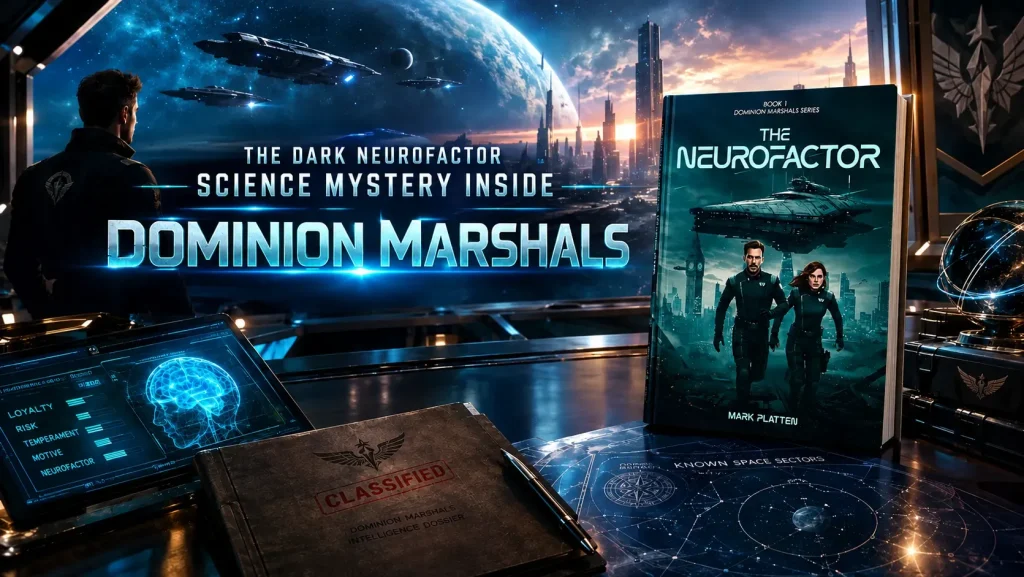
The Neurofactor kicks off Mark Platten’s Dominion Marshals series with a space mystery built around a psychological scoring system used to judge people’s motives and loyalty, one that turns out to be far less reliable than anyone wants to admit. Instead of nonstop battles, the story leans on slow-burn political intrigue and clues planted early that only click into place chapters later. Platten’s own background in engineering shows through in how grounded and lived-in the galaxy feels, making this a solid entry point for readers who want their space opera to come with real stakes and a puzzle worth paying attention to.
Introduction
Pick up The Neurofactor expecting a straightforward space battle and you get something stranger. Mark Platten wrote a dark Neurofactor science mystery instead, one where the real danger isn’t a warship or an alien fleet. It’s a machine built to read people, and almost nobody trusts what it finds.
What Makes This a Dark Neurofactor Science Mystery
Here’s the setup. The Dominion Marshals police a stretch of galaxy where trust runs thin and paperwork runs thinner. To sort friend from threat, the Marshals lean on a scoring system called the Neurofactor, a psychological read that ranks people by temperament, risk and hidden motive. Sounds tidy on paper. It isn’t. The people running that system have their own agendas, and the story spends its whole runtime asking what happens when the tool meant to judge character starts shaping it instead.
You’ve probably read plenty of books where the machine or the algorithm turns evil in some obvious, cartoonish way. This one doesn’t do that. The Neurofactor isn’t a villain. It’s a mirror, and mirrors lie just as often as they tell the truth.
The Prism and Other Pieces of a Lived-In Galaxy
Mark Platten backs this up with real texture. Dominion Marshals bonus material introduces The Prism, an intelligence hub run by a survivor of what the lore calls Sisterhood trauma, someone who built an independent spy network rather than lean on official channels. Details like that don’t feel bolted on. They feel like a world that existed long before page one and will keep existing long after the last chapter of this series.
Galactic Diplomacy Neurofactor Story: Politics With Teeth
Call it a galactic diplomacy Neurofactor story if you want the short version. Alliances in this galaxy don’t hold because everyone plays nice. They hold because breaking them costs too much, until suddenly it doesn’t. Factions trade favors, sit on old grudges and quietly test how far a rival will bend before it snaps.
None of this resolves the way a tidy political thriller usually resolves. Some deals hold. Others fall apart off page, mentioned only in passing later, the way real politics actually works. That’s a deliberate choice, and it’s part of why the story reads more like an unforgettable neurofactor space politics novel than a laser fight in space with extra steps.
Cosmic Mystery Neurofactor Book: Clues That Actually Land
The mystery structure deserves its own mention. Early chapters drop small, easy to miss details: a name mentioned once, a report nobody reads twice, a Marshal who hesitates a beat too long. Nothing gets explained right away. Chapters later, those same details snap into place, and you’ll want to flip back and check what you missed.
If you’re the kind of reader who rereads chapter one after finishing a book, this one rewards that habit more than most. That’s the engine behind calling this a cosmic mystery Neurofactor book rather than just another space adventure with a mystery label stuck on top. The clues aren’t decoration. They’re the plot.
A Writer Who Spent Decades Building Real Systems
Mark Platten didn’t come up through creative writing workshops. His working life ran through engineering, the kind where a wrong call on a live system carries real consequences, not just plot consequences. That background shows up in how this galaxy is built. Nothing in the Dominion Marshals universe feels decorative. Every piece of technology, every chain of command, every failure point exists because it has a job to do.
Readers looking for the best sci fi Neurofactor novel to start a new series with often mention this exact quality first. The world holds together because someone who spent years around complicated, failure-prone systems designed it that way, then handed it to characters who don’t always trust the system either.
What Comes After The Neurofactor
The Neurofactor opens the Dominion Marshals series, and it doesn’t try to wrap up everything on its own. Mark Platten has already announced Eclipse Rising and Fragments of Tomorrow as the next chapters, with Legacy Edge lined up further down the road. Readers who want to unveil Dominion Marshals galaxy epic books beyond this first entry already have a clear path forward, even while several of those titles still sit marked as coming soon.
Whether the payoff across those future novels matches the setup here is something only more pages will answer. Right now, though, the foundation feels solid enough to justify the wait.
Where to Start
If dense, self-serious space opera has worn you out, this dark Neurofactor science mystery is a different kind of read. It trusts you to hold onto small details, sit with characters who don’t get clean answers and watch a galaxy-spanning system slowly reveal what it was actually built for.
The Neurofactor is available now on Amazon for $24.99, and it’s the simplest way into a series that’s only going to get bigger from here.
Frequently Asked Questions
Is The Neurofactor more of a mystery or a straight-up space battle story?
It leans mystery first. There’s action throughout, but the pacing is built around slow reveals and shifting loyalties rather than nonstop combat. If you came here looking for a dark Neurofactor science mystery with real stakes attached to the puzzle, that’s exactly what you get.
Do I need to read the bonus dossiers before starting the book?
No. The novel stands on its own. The dossiers and ship bible add extra depth for readers who want more, but nothing in the main story assumes you’ve read them first.
How grim does the story actually get?
Characters make mistakes, some of them costly, and the politics don’t always end fairly. It isn’t grimdark, but it doesn’t pull every punch either. Readers who want moral complexity alongside their space opera tend to respond well to that balance.
Is this a good entry point if I haven’t read much space opera before?
Yes, mostly because the world explains itself gradually instead of dumping lore in the first chapter. You pick up the rules of this galaxy the same way the characters test them, one decision at a time.